Full-stack product / August 2026
ParkHub
A two-sided marketplace prototype that makes privately owned parking spaces discoverable and bookable.
SYNCS Hack · Team prototype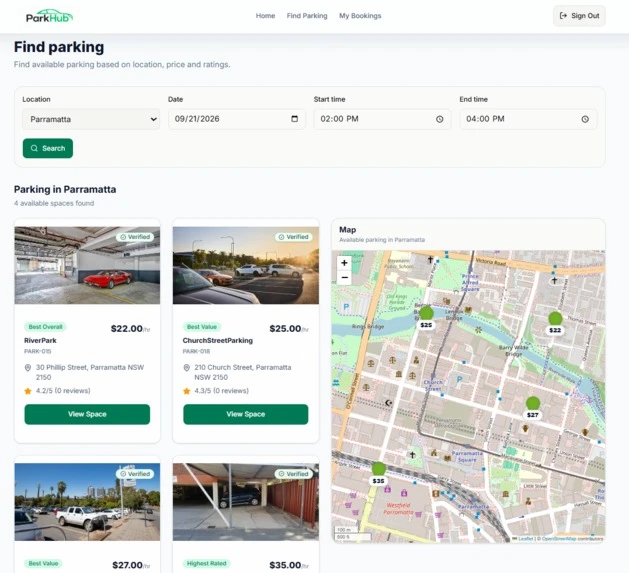
The problem
01Drivers need a parking space that is actually available when they arrive. Space owners need a clear way to offer availability, manage bookings and understand earnings. A useful marketplace has to connect both sides of that journey.
Team & contribution
Built with a team for SYNCS Hack 2026. The product, engineering and award are shared team achievements.
Approach & architecture
02Discover
React interface for driver and host workflows
Book
FastAPI REST endpoints and authentication
Persist
PostgreSQL on Supabase for marketplace data
Checkout
Stripe test-mode payment flow
Conceptual system flow, based on the project summary.
Engineering decisions
03Availability before a booking
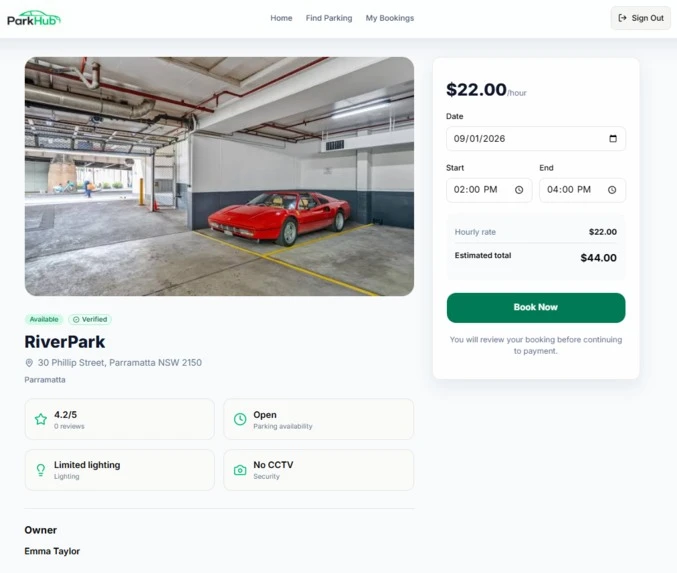
Search and ranking consider price, ratings and booking conflicts. Availability is part of the discovery problem, so a convincing result needs more than a location and a price.
Design for both sides
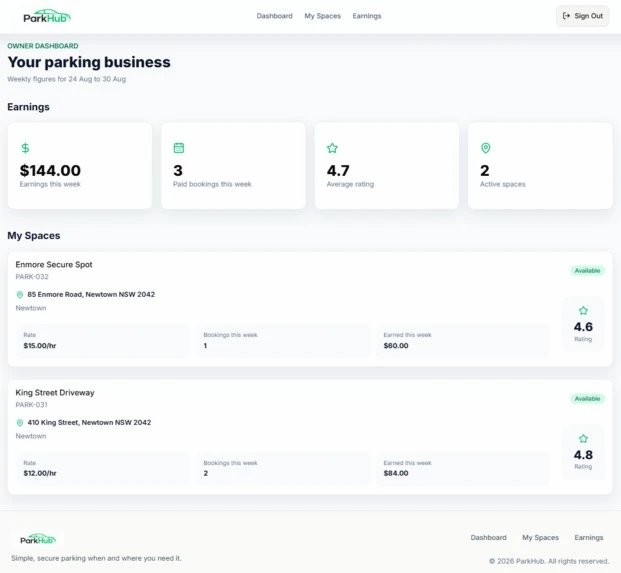
We connected the driver’s discovery and booking flow with owner earnings dashboards. Treating hosts as first-class users helped make the marketplace experience coherent.
Connect the interface to real data
React communicates with a FastAPI backend through REST APIs, with PostgreSQL hosted on Supabase. This gives the prototype a database-backed booking flow rather than a collection of disconnected screens.
Constraints & trade-offs
04A hackathon leaves limited time for implementation and UX iteration. The scope was a working prototype, with test payments; production payment handling, commercial operation and production-scale reliability are not claimed.
Outcome & reflection
05Our team won the Best UI/UX Award at SYNCS Hack 2026, awarded by the Sydney Computing Society in August 2026.
The project connects an engineering concern—availability and booking state—with a user concern: knowing whether a space can actually be booked. That connection is the most useful lens for understanding the work.
Screens & outputs
3 IMAGESSelect an image to open it at full size.